Edival Ramosa
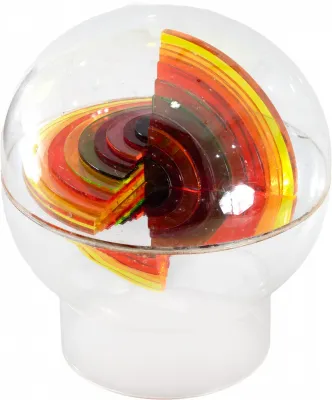
Globe
acrylic sculpture26 x 22 x 22 cm
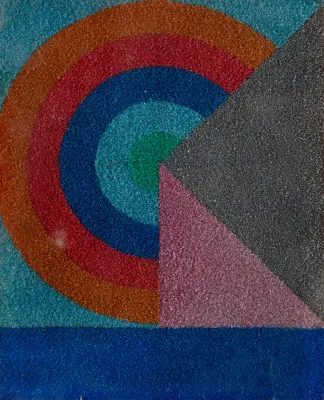
Geometric
colored sand27 x 21 cm
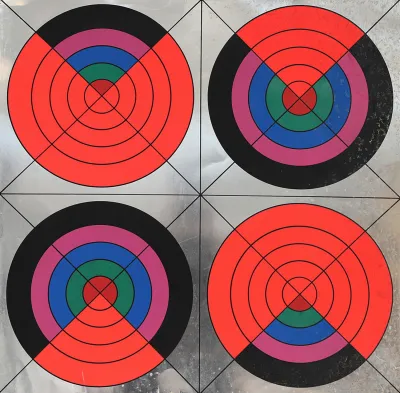
Edival Ramosa (São Gonçalo/RJ, 1940 - Niterói/RJ, 2015)
Edival Ramosa is a Brazilian painter, sculptor and visual artist. Edival Ramosa is an artist whose trajectory synthesizes the multiple layers of Brazilian identity: Afro-indigenous, mestizo, ex-combatant, traveler and visual creator. Born in 1940, in the city of São Gonçalo, in the state of Rio de Janeiro, he built a work marked by symbolic strength, technical sophistication and cultural and ancestral consciousness. Throughout his career, he moves between the constructive abstraction of the European tradition and the rituals of indigenous and Afro-Brazilian cultures, developing a work that integrates historical, spiritual and political experiences. In 1961, at the age of 21, he joined the United Nations Peace Expeditionary Corps, acting in the Suez Battalion during the conflict between Egypt and Israel. This experience had a profound impact on his perception of the world and of art. In the Middle East, he came into contact with ancient cultures, especially Egypt, whose monumentality and symbology were initial sources of inspiration for his artistic practice.
In 1964, Edival Ramosa moved to Italy, establishing himself in Milan for a decade. During this period, he joined the vibrant European post-war artistic scene and worked with artists such as Arnaldo Pomodoro and Lucio Fontana. The coexistence with these names and the debates of modern European art were decisive for the consolidation of their visual language.
During its Milanese phase, its production was marked by the technical rigor and the influence of constructivism, kinetic art and op art. It used geometric shapes, optical games and industrial materials, such as enameled wood, stainless steel and acrylic, seeking balance and visual precision in line with the rational aesthetics of European art of the 1960s.
Edival Ramosa's return to Brazil, In 1974, he marked a radical transformation in his trajectory. Establishing himself initially in Cabo Frio, he undertook an expedition of a year and a half between indigenous communities in Roraima. This contact with the original worldviews profoundly impacted his art. From this experience, he began to incorporate natural and artisanal materials such as straw, feathers, skins, bamboos and beads, absorbing values such as symmetry, functionality and ceremonial symbolism.
This aesthetic turn was accompanied by an intense reflection on his Afro-indigenous ancestry. Edival Ramosa has always clearly assumed his mestizo origin. In a remarkable statement, he wrote: “Black black. Born of a black mother, daughter of Indians and father the son of a black woman from Africa and a Portuguese father. […] Poor Indians and poor mestizos...”. This identity awareness runs through his work, making it a visual manifestation of cultural resistance and historical reinvention in the face of colonial violence. Brazilian. According to the critic Roberto Pontual, “the refinement, elegance and technological cleanliness of before have now merged with a ritualistic counterpoint”. Its production stands out both for its technical domain and for the ancestral, spiritual and critical strength it carries.
Edival Ramosa's art challenges the binarisms between modern and archaic, urban and tribal, art and artifact. Critic Jayme Mauricio, in the newspaper Última Hora in 1973, summarized this complexity: “Without launching Anthropophagic Manifesto, Edival Ramosa makes a champion of the rhythmic, magical, chromatic and mystical arsenal of culture Afro-indigenist of his land...”. This reading reveals the core of the artist's project: giving universal visibility to marginalized cultures, with aesthetic dignity and historical consciousness. His sculptures evoke ceremonial instruments, masks and totems, proposing sensory and spiritual experiences. For him, the artistic object is a mediator between the visible and the invisible, the past and the present.
The importance of Edival Ramosa in contemporary Brazilian art lies in its ability to articulate ancestral traditions with a current aesthetic discourse. His work goes beyond the market or galleries, dialoguing with memories, non-hegemonic knowledge and historically silenced bodies.
In a country where indigenous and black populations face structural violence and historical racism, the art of Edival Ramosa acquires political contours. However, its language is not pamphleteering: it operates by metaphors, symbols and subtle vibrations, celebrating diversity as an essential value.
Edival Ramosa participated in several national and international exhibitions, taking with him the sensitive testimony of his cultural experiences and heritage. Although part of his work still needs greater institutional diffusion, his contribution to Brazilian art is original, profound and necessary. Its legacy resides not only in the works, but in the transformation of the personal experience into a poetic language of universal scope.