Eliseu Visconti
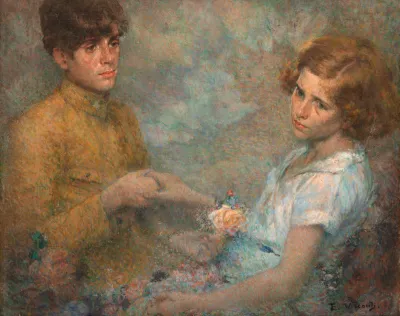
Young Couple
oil on canvas1927
63 x 80 cm
signed lower right
Registered in the Raisonné catalog with code. P252.
Eliseu Visconti (Salerno, Italy 1866 – Rio de Janeiro, RJ, 1944)
Painter, draftsman, teacher.
Eliseu D'Angelo Visconti moved with his family to Rio de Janeiro between 1873 and 1875, and in 1883 began studying at the Liceu de Artes e Ofícios with Victor Meirelles (1832–1903) and Estêvão Silva (ca. 1844–1891). The following year, while still attending the Liceu, he enrolled at the Imperial Academy of Fine Arts (Aiba), where his teachers included Zeferino da Costa (1840–1915), Rodolfo Amoedo (1857–1941), Henrique Bernardelli (1858–1936), Victor Meirelles, and José Maria de Medeiros (1849–1925). In 1888, he left the Aiba to join the Ateliê Livre, which aimed to modernize traditional teaching. With the changes brought by the Proclamation of the Republic, the Aiba became the National School of Fine Arts (Enba). Visconti returned to the institution and, in 1892, was awarded a travel grant abroad.
He went to Paris and enrolled at the École Nationale et Spéciale des Beaux-Arts; he also studied decorative arts at the École Guérin under Eugène Samuel Grasset (ca. 1841–1917), one of the introducers of Art Nouveau in France. He traveled to Madrid, where he copied works by Diego Velázquez (1599–1660) at the Museo del Prado, and to Italy, where he studied Florentine painting. In 1900, he returned to Brazil and, the following year, held his first exhibition at the Enba. He created the ex-libris for the National Library in Rio de Janeiro and won the competition for postage stamps and postal stationery in 1904. In 1905, he was invited by the city’s mayor, engineer Pereira Passos, to produce panels for the decoration of the Municipal Theater of Rio de Janeiro. Between 1908 and 1913, he taught painting at the Enba, resigning due to dissatisfaction with its teaching standards. He returned to Europe between 1913 and 1916 to complete the decoration of the theater’s foyer, settling permanently in Brazil in 1920. According to some scholars, he is considered a practitioner of Art Nouveau and industrial and graphic design in Brazil, producing works in ceramics, textiles, and lighting.
Critical Commentary
Eliseu Visconti attended the Liceu de Artes e Ofícios in Rio de Janeiro in 1883 and later studied at the Imperial Academy of Fine Arts (Aiba), where his teachers included Victor Meirelles, José Maria de Medeiros, Henrique Bernardelli, and Rodolfo Amoedo. In 1888, he studied at the Ateliê Livre, created by Henrique Bernardelli, Rodolfo Amoedo, and Rodolfo Bernardelli (1852–1931), in protest against the Academy’s traditional teaching methods and modeled after the Académie Julian in Paris.
With the Republic, the Aiba was reorganized and renamed the National School of Fine Arts (Enba). Visconti returned and became the first student to receive the reinstated travel grant abroad in 1892. He refined his studies in Paris at the École Nationale et Spéciale des Beaux-Arts and also studied decorative arts at the École Guérin with Eugène Samuel Grasset, which fostered his interest in Art Nouveau. His contact with Italian Renaissance masters, especially Sandro Botticelli (ca. 1444–1510), and with Symbolism is reflected in his painting through the linearity of figures, as seen in Gioventù (1898) and The Dance of the Oreads (1899), both awarded at the 1900 Paris International Exhibition, the same year he returned to Brazil.
At a time of artistic modernization in Brazil, his work embraced major international trends of the late 19th and early 20th centuries. He sought to strengthen ties between art and industry, holding a solo exhibition in Rio de Janeiro in 1901 that included designs for objects in iron, ceramics, marquetry, stained glass, textiles, and wallpaper. From 1903 onward, he alternated between France and Brazil. In 1904, he created the ex-libris for the National Library and won a competition for postage stamps. In 1905, he painted a portrait of sculptor Nicolina Vaz de Assis (1874–1941), one of his most representative works in the genre, emphasizing elegance and dignity. That same year, he was commissioned by Pereira Passos to decorate the Municipal Theater of Rio de Janeiro.
His work shows strong Impressionist influence, with lighter and more luminous colors. The theater’s curtain is one of his most allegorical works, with a slightly Symbolist character, depicting a procession of notable figures—artists, musicians, and poets—with composer Carlos Gomes (1836–1896) as the central figure. Female figures dance in flowing drapery against a background of blues and pinks, rendered with light brushstrokes.
His wife, Louise Visconti (1882–1954), and their children frequently served as models. He became known for his colorism, as seen in Maternity (1906). According to critic Mário Pedrosa (1900–1981), contrasts of color and the beauty of fabric textures are central themes. His work reflects studies made directly from nature, such as landscapes of the Luxembourg Gardens in Paris.
In 1906, while still in France, he was appointed professor of painting at the Enba, a position he held from 1908 to 1913. During this period, his work approached Pointillism, as in The Rose (1909). In Portrait of Gonzaga Duque (1908/1910), he depicted the leading art critic of the time in a realistic manner.
In 1913, he returned to France to decorate the foyer of the Municipal Theater with three panels—Music, Poetic Inspiration, and Musical Inspiration—featuring ethereal figures in soft, undefined tones. In 1920, he returned permanently to Brazil. He painted numerous landscapes, such as Sun Cure (1920), set on his property in St. Hubert, near Paris. Later works, including landscapes of Teresópolis, Rio de Janeiro, emphasize atmospheric effects, color, and light.
Visconti also produced many self-portraits. Initially sober, they later became more vibrant, with broader brushstrokes. Often, he depicted himself as a painter holding a palette or brushes, as in Lost Illusions (1933). An eclectic artist, he freely explored contemporary movements such as Art Nouveau, Symbolism, Pointillism, and Impressionism, contributing to the modernization of Brazilian art.
Criticism
“With Rodolfo Amoedo, Henrique Bernardelli, J. Medeiros, and Zeferino da Costa, he learned a craft—the craft of painting. But it was through himself, and through his time in Europe observing the masters, especially the Venetians, that he learned something deeper: painting itself… He created a style, established a personality, and for this reason became the great painter he is.”
Frederico Barata
“Visconti was the most important artist of the first third of the century in Brazil not only because he knew how to paint, but because he painted something new.”
Mário Barata
“Visconti will be the key figure in the emergence of modern painting in Brazil… introducing Impressionism and Divisionism into Brazilian art.”
Quirino Campofiorito
“Impressionism reveals his true personality; his palette approaches the purity of the solar prism… later, in Brazil, he becomes a master of atmospheric effects.”
Mário Pedrosa
Statements
“I am a presentist. Art cannot stand still. It changes constantly… Futurists and Cubists are all respectable expressions… They shake, renew, and are therefore worthy of admiration.”
Eliseu Visconti
Source: Itaú Cultural